SPECIATION
When Boys Are Not HuMan

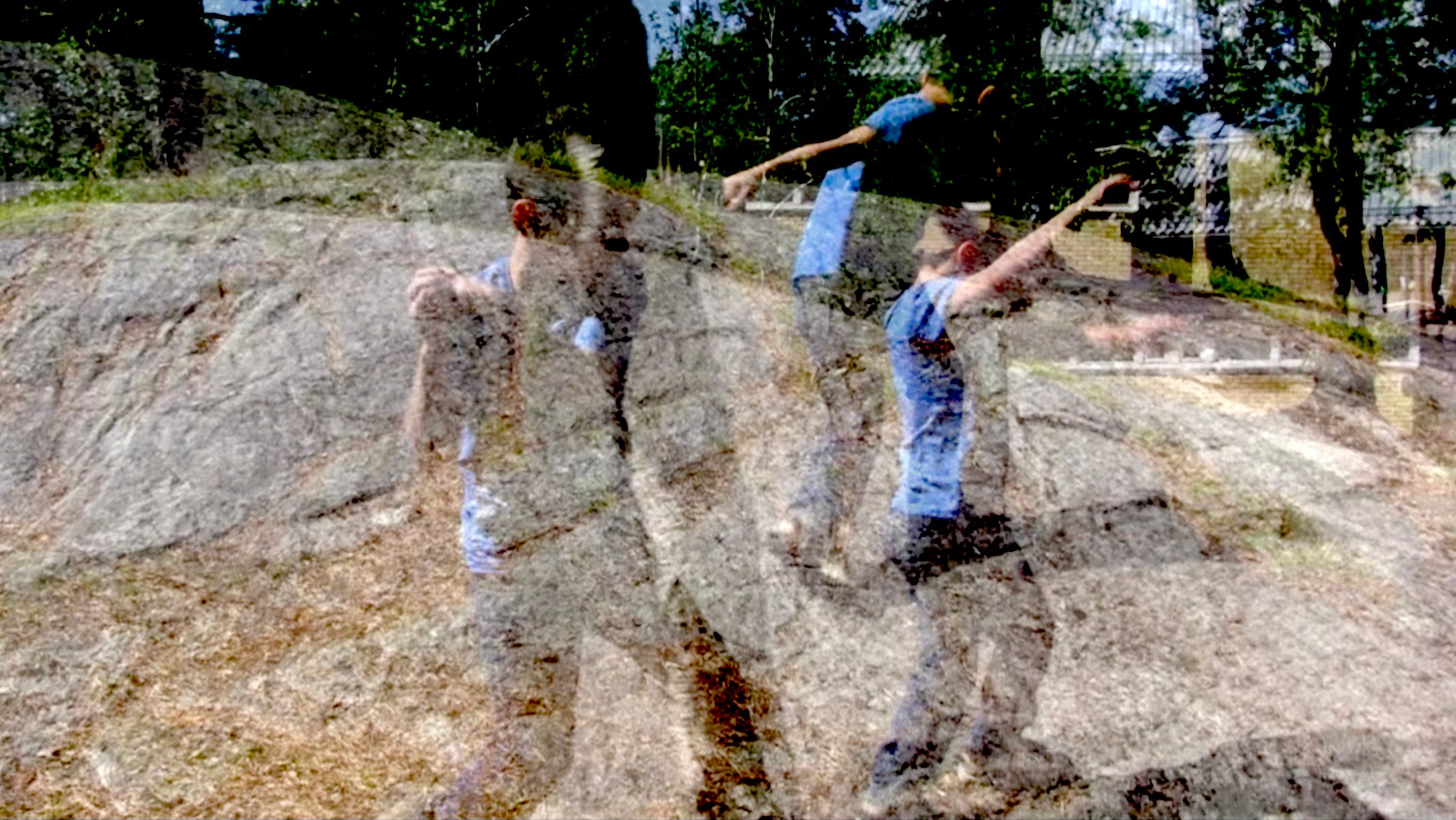
In an earlier post on gender identity categories and the feral powers of existence they reduce and contain (“The Trials of the Man-Standard”), I ended with a promise to post a follow-up essay on the concept of “speciation.” This is that essay.
Speciation is a way of thinking the multiplicity of modes of moving/thinking/feeling that indwell the body and vitalize it, before it is gridded into determinate categories and overlaid with the norms and mechanisms of control they convey. It lies before, beneath, and across those griddings. Speciation is an on-going process of differentiation in an open field, moving skew to the settlements of Man. Its field remains restless and open: there is no determinate species that is become. It is not the opposite of the gender/sex complex or other normative schema applied to the human body to channel its capacities and passions. It is, rather, their processual alterstory, in leakage from and excess over any system of categorical determinations that may apply themselves to overcoding the welter of potential that is a life.
The word “speciation” is not to be taken in its traditional taxonomic meaning in the biological sciences. Neither is it to be taken in a Marxist or post-Marxist sense of “species-being,” designating the full realization of essentially human potential through work and the transformation of nature. Here, it is a question of play. It is more allied to a rebecoming-animal of the human than it is to the becoming of the human animal ending in the achievement of Man (sometimes referred to as hominization). The HuMan in the title refers to the concept of the “Man-Standard” as developed in that earlier post. The Man-Standard is the master-figure of species-being. It is the categorical operator, in our historical epoch, of hominization. Whenever “human” is used in this essay, an echo of this concept should be heard. The usage of “speciation” activated here descends from Erin Manning’s proposal of an alternative concept in her book Always More than One.1
I hesitated posting this now, an essay about war play, in a world torn apart by actual wars, senselessly multiplying on numerous fronts. It might come across as tone-deaf. But the whole point is that war play can, paradoxically, counter-actualize the conditions of actual war. Like many other forms of play, and collective creative activity in general, it can be, in Deleuze and Guattari’s words, a “war-machine” that does not have war as its object. Such is the case when the “object” is the group-subject.
* * * *
I won’t say I any more, I’ll never utter the word again; it’s just too damn stupid. Every time I hear it, I’ll use the third person instead, if I happen to remember to. If it amuses them. And it won’t make one bit of difference..
— Beckett, The Unnamable
I ask: how is it that a young body assigned masculine gender on the basis of anatomical appearance might deeply disidentify with the male, consciously side its self-image with women, and still joyously participate in boy play?
I seem to remember: it is from around the ages of five to nine that this paradoxical possibility was most available. This is an age where some boys run in play packs. The pack can be as small as two, generally not more than five.
I speculate: just two qualifies as a pack by its quality of movement. It is a question of how the pack runs. A pack is off and running when the individual bodies are swept up in a concertation of improvised rhythms. Their movements smooth into a collective flow that carries them away in its momentum. They are no longer self-consciously separate selves interacting with one another as independent variables. They are bound variables: the slightest gesture of one, the mere flicker of an inclination, rebounds across the others in a collective inflection, with the immediacy of action at distance. The individual bodies are not so much parts as reverberating part-vectors, composing in and for the flow on the fly. In the flow, on the fly, two is as good as more than a few. Number outdoes itself. It runs, qualitatively, beyond its count. Experientially more than a mere few, shy of a whole lot. A several. Severality has a dynamic all its own. 2
Severally, I recount.
Slinking on all fours, carefully placing the back knee where the front paw on the same side just was, in good feline form, with a slight sway at the shoulders. The bodies move in formation, the one with the best slink in front, the others following in formation, attuning their movement to the style set by the paragon. The pace quickens. Time is of the essence. The human advance troops have captured the dog detachment, and every creature knows what humans do to nonhuman captives and insubordinate animals. Just ask any cow or rat. The sasquatch batallion, the most versatile and powerful in the animal army, is fighting on another front, too far way to help. The cats will have to go it on their own. Upon arrival at the enemy camp, they see a hedgerow that offers an ambush opportunity. Let’s make it that the cats have blades attached to their retractable claws! In unison, the cats flex their claws. One leaps through the bushes, pirouetting in the air, slashing with feline acrobatic grace. He’s down! A second cat pounces, then a third. Cat power! It goes in rounds. After each has pounced, the cats re-hedge. The battle proceeds in waves. Human defenders, rushing to engage, are mowed down one after the other. Before taking a turn, each feline attacker is riveted to the last one’s gestures, as if inwardly rehearsing them in sync with their happening. Then the turn comes, and a relay movement erupts, with a studiously added flourish. A stylistic arms race ensues. The battle intensifies. Through its cyclic rhythms, the pirouettes wax more extravagant while the slashings, in contrast, increase in nuance. Feline bodies ride the rhythm. Suddenly: I’m down! I’m dead! The rhythm breaks. Cats gather around to mourn the fallen. From one bursts a howl. The dead arises, reawakened to the battle. A frenzy of barking spontaneously overcomes the pack. Let’s say that the dogs have escaped their pens! They’re attacking the humans from behind. Slinking turns into loping, pirouettes transition into lunges, slashing into gnashing of teeth. Pincered between two sallies, the humans don’t have a chance. It’s over quickly. The dogs catch their breath before rounding up the survivors to be marched to one of the already crowded human reservations. They will remain confined there in perpetuity, on rations, to prevent them from wreaking further destruction upon the earth. The animal army has chalked up another victory in the ongoing saga of their anti-human global revolution. The pack moves on, roving, seemingly aimlessly, but actually following an inodorous scent trail to a new location that will propose itself as a trigger for the next installment. The saga continues.
Implicitly, they feel it: for many adult observers of a scene of this kind it will be all about violence. The boys, their implicit gaze is saying, are reveling in blood and guts and death and fantasies of concentration camps. This kind of thing has to be suppressed. Never give a boy a war toy. But what is to be done when a stick spontaneously combusts into a sword, and a hand morphs into a pistol? The urge seems irrepressible. What is it with boys? It’s just all too depressingly predictable. It is maybe not so common that animal armies are on the march, as in this anecdotal example from the mid-1960s, in which a boy-pack grand-fantasy narrative prefiguratively channels the zeitgeist of the second-wave environmental movement’s coming breakthrough into general consciousness. These days the urge to war play is more predictably grafts onto existing narratives from video games, anime, or superhero and science fiction movies. Where cats once pounced, ninjas leap with beyond-feline prowess and even soar in defiance of gravity, their bodies stretching like organic elastics. Forgotten, marginal, downtrodden figures magically acquire superpowers whose use is obligatorily accompanied by a signature sound effect. Otherwordly robots or rogue machines with superior strength or machine-sharp cunning help save the unfortunate and protect the weak, or more enjoyably, doom humanity. It’s enough to bring on moral panic about the deleterious “impact” of media technology. And it has.
Their older self suggests: instead of panicking – or while panicking – try to see it through another lens. Note, first of all, the nonhuman accent of war play. If it’s not animality in play, it’s posthumanity. This is enough to justify entertaining the hypothesis that something more than the base-line normalization of boys into all-too-human adult-male style aggression may be at stake – even if that patriarchal normalization is also playing out, preparatorily, as through a self-conducting initiation ritual. Take this opportunity to focus on that aspect of the more-than. Ask: what else might be happening here? Is there a something else going on, even in this worst-case scenario of boys indulging in war play in structural exclusion of girls, that may nevertheless point in a different direction, away from gender normalization? Might something supernormal,3 above and beyond, or beneath and across, the normopathy of human gender roles be in joyful accompaniment, sounding an initiatory note of its own?
* * *
Child educator Ebba Theorell asked the question of the “what else,” impelled by her own conflicted feelings, not to mention her sense of moral judgment from her peers, at her sons’ irrepressible penchant for war play. Sensing a something-more, she decided to dedicate her PhD research to the question.4 The results are rich with implications.
First, imitation. Boys in war play take turns emulating each other’s moves, and the moves imitate a genre, such as sword fighting. This is easily interpreted as role-modeling for homosocial solidarity in activities coded male. But what Theorell sees is that the play starts in imitation, then quickly veers off to “develop into an expression of its own” powered by a “fascination with the form, power, rhythm, musicality and precision of the movement.” (161) The boys fall into a “common tempo or rhythm” in “unspoken agreement.” (87) The rhythm, however, is “irregular and each repetition has its own particularity and variation.” (87) The children are improvising – less on each other than on the movement quality each in turn embodies. The silent agreement appears to be “to find, emphasize, and experiment with the aesthetic energy of the movement.” (164) The boys are as if possessed by movement quality. Through their performing of movement forms, movement performs qualitative variations on itself. The movements “transform and renew,” “in an ongoing, unstoppable repetition from generation to generation” (164). The boys are taken up, irrepressibly, in this ongoing generation of movement variations. Their host bodies are carried away by it.
Given the tempo of the turn-taking, it is necessary for the next one up to “understand exactly what the other person is going to do even before the movement takes shape.” (132) The players move into movement from what Erin Manning calls its “preacceleration”: its welling in incipient feeling on the way to action.5 The preacceleration is a mode of sensitivity that couches responsiveness in the formative level of actions. But “it is not just about responsiveness or sensitivity … there is an aesthetic connection, aesthetic depth, and dimensions to this responsiveness that cannot be explained as merely psychological or physiological.” (139) The activity the boys are engaged in is a “kinaesthetic musicality,” a kinaesthetic aesthetics, hinging on qualities of lived movement, movement lived-together: vitality affect.6 It is vitality affect to which the boys attune. The skill they are honing is to “feel the movements of other people” (128), but at a certain level of abstraction: from any given iteration of form, by virtue of passing through a series of them; from any single performing body; and from any use.
It is often said that the use-value of play is to serve as training, in hunting for animals, and war and macho posturing and brawling for HuMen. The paradox is that in war play “the intention of violence has to be disconnected in order for the movement to be as violent as possible” (110) For the action to be as violent as possible, it must be not at all. The drive is to have the acuteness of vitality affect that can come with intensifiers of experience like violence, but without the violence. Actual violence is a betrayal of war play. Play violence is purely qualitative; concertedly aesthetic; more musical than combative. The imperative to disconnect from violence is seen in the solicitude war players show for each other. The boys take great care that their performances do not impinge upon each other’s bodies. (127) Otherworldly weapons, abstractly wielded, encounter no earthly flesh. What is this practice in hosting the intensification of experience “for”? That is not the question. To which the non-answer is: just because (just because it is what it is: heightening of experience).
Actual violence begins explosively, engages frictionally, then wanes entropic. It exhausts itself in its desired effect, which is to hobble or eliminate the other’s vital powers of movement and variation. War play is negentropic, positively sweeping bodies up in qualities of movement whose variations take on momentum, carrying intensity forward. It is anti-frictional, only ever landing abstractly. Its explosions smooth into a continuing pulse of rhythmic up and down beats, subsiding periodically into a “dead pause” (“I’m down!) that is in no way in contradiction to movement, but rather marks the degree zero from which it no sooner re-arises for fresh pulse. (112-113) It does not oppose bodies to each other in struggle, but rather composes their powers of movement and variation in the play of a complex counterpoint.
Boy bodies in war play “form a field of action between people in motion where they all constitute an infinite and open continuation of each other.” (127; emphasis added). “People are part of collective patterns, rhythms and melodies.” (138; emphasis added) They are part-subjects. If agency is motive force, then here the play is its own agent. The momentum of the “infinite and open continuation” of movement variations passing between bodies and sweeping them up in itself, is of itself the agent. The collective patterns, rhythms and melodies is the subject of the movement. The subject is the play. The play is moving; it self-moves. The individual bodies involved are part-subjects populating its field, inducted into its action. Their patterned collectivity constitutes a group-subject.
Group-subject is another name for severality: some bodies kinaesthetically-aesthetically outdoing themselves.
Because what is activated in group-subjects is not interiority but the in-between, they are sensitive to outside impingements. The in-between connects to the outside. It is like a marbling of the inside by veins of exteriority that holds gaps between bodies and at the same time brings them together, threading among and around to surround. It forms an immersive medium whose substance is actionable distance, a dynamic gap. The in-between is in constant recomposition as bodies leap, meet, divide, and fall into its energizing intervals. These dilate, contract, and contort apace. The elasticity of the in-between breathes rhythmic action into the movements of the group-subject, like an untouched bellows feeding a flame. This is the space where the motive force lives. It is where the continuation of the play toward infinite variation takes place.
The veins of the in-between are like capillaries that aliment the life of the group-subject. A hedge that happens to be in the vicinity is sucked into play as an action trigger. Its outsideness becomes immanent to the play, as a modulator of its continuation. A random sound in the distance enters as a war cry from a rival army, and the play deflects into a new direction. Outside impingements and affordances combust into formative factors of the play under way, fluttering its flame like a breeze on a candle. The constitution of the group-subject “include objects, places, and other nonhuman organisms” (138). It extends to the nonhuman, not only of animality, monstrosity, and superheroism, but of the Outside. A group-subject attunes to the outside, welcoming its nonhumanness into its own dynamic constitution. In war play, boys are not human. Or not only: they are actively more-than human. Any body that has experienced severality has felt the magic of “going out to play” not just as leaving the domestic orbit and setting out into the world, but as moving into another world, where this world opens onto more-than human intensities of possible worlds.
Language, widely considered the human organ par excellence, in fact operates on the same nonhuman register as the hedgerow. It triggers. The triggering is folded in. A veer and variation ensues. “Let’s say …” “Let’s make it that …” And it is made so. Here, language is performative. It is acting in direct circuit as an action modulator. It also operates narratively, setting the scene for the action. This can be through improvised grand narratives or narratives borrowed from media. This is not just describing a context. It is not only operating on the level of signification. It is just as performative. The narrative acts as an integral transformer. Everything around will take on a new aspect. A rock, in addition to being a rock, will morph into a launch pad for an interstellar fleet. A stick will be immediately recognized as a ray gun. Outside factors are transformatively enfolded into the action’s unfolding. Beyond signification: performative fabulation. War play is no more beholden to the normative functions of language (monosemic denotation, veridical description, accurate representation) than it is to practical use-value. How then can it be said to signify or represent maleness?
And yet it does. We all know it does. Also. It is overcoded with that meaning. All-too-serious narratives try to frame it. Normative factors bubble in through the veins of outside, delivering gender-based role-modeling into the breathing of the pack. To the extent that these impingements succeed in making the play signify maleness, the group-subject is attenuated. It dons a more HuMan face. It begins to function as practice for male adulthood, in the ways any parent with a feminist fiber in their body fears. The war play itself is not sufficient to human-form the boys. It requires many overlapping contexts and numerous processes converging toward that end. One of them is organized sports.
Organized sports offer intensities of movement not unrelated to pack life, as seen in the choreographies of movement in soccer or hockey. But the choreographies are framed by rules and disciplined according to them. Packs generate rules, in constant performative mutation (“let’s make it that …”). Sports have rules, and stand by them. Pack rules are constantly changing, at the speed of fabulation. Sports deploy a form. Pack play unfolds a variation. Sports frame. Play opens. The very status of number changes. In organized sports, severality goes down for the count. There is a set number of team members, keeping score, for a set duration of play. Number is no longer left to outdo itself in the infinite and open continuation of qualitative variation. It channels bodies into competitive play where, as in actual war, there are winners and losers. Organized sports are normed war games that explicitly set out to train boys into men. A sign of the demise of the group-subject is the presence of the leader. A pack has paragons. A particular boy may command emulation by the quality of his movements, but the emulation begins only in order to give way to variation. The paragon operates as a catalyzer. And that status is fickle. It can jump from one body to another at any moment. Leadership in organized sport is resolute. It is structured into enduring roles, such as coach or team leader, with less exalted roles arrayed beneath them. Bodies subjectify around the roles, which they are encouraged to experience as reflecting a participation in some kind of essence defining their inner nature (for example, when it is said “this boy is of leadership caliber”). The exercise of leadership is proto- or quasi-military. It can be performative, but no matter what else it performs, it is also performing hierarchy and authority. The group-subject’s members’ open continuation of each other closes into a system of subsumption, under a leader and under a supposed essence conferring a socially recognized value. The group-subject has become a subjected-group. The pack has become a corps.
Under these conditions, the vitality affect of play is converted to the cause of hetero male sociality fueling patriarchal society’s masculinist tendencies. It is socialized.
The word tendency is key. The nonhuman group-subject is a tendency: a potential vector. The masculinist corps is another tendency. They may co-inhabit the same bodies and overlap in the same situations. They are two coincident registers, counter-inflecting a body’s movements and vital affect. The problem of the pack is how not to become a socialized corps: how to ward off the human gendering. The problem of the corps is how to channel the pack’s energies into its own operations. The only way a corps can induct the run of pack bodies into its own more or less regimented movements is to offer a taste of the vitality affect of the pack as a lure. It must translate the immersiveness and feelings of intensity that move through packs into its own register, subsuming them to its frame. Pack life has primacy: corps life depends on it for the motive force. The corps is a disciplined derivative of the pack. It is an institutionalized, normativized capture of pack energies. Packs run. Corps march. Packs improvise their own rhythm on the run. Corps march to the same drummer.
If boy bodies’ induction into a corps is an integral part of a socialization process of gendering them male, what process are they in when they are running with the pack? Call it speciation. Every group-subject is qualitatively different. The number its severality takes off from conditions its dynamic, which in turn conditions the vitality affects it expresses. The unique aspects of its surrounds are effective factors of its processual outside, and can infold to play a formative role as triggers, to singular result. Individual bodies’ propensities and dispositions inform and inflect the ongoing generation of variation. The group-subject is sui generis: a kind of its own; a singular species. A subjected-group, by contrast, operates on a principle of conformity to a model. It subsumes bodies under a general category, as particular cases of it. While it cannot suppress all singularity, so that it must regulate rather than eliminate variation, it strives to produce a degree of uniformity ensuring each bodies’ recognizable inclusion in the category. This vouchsafes its identity. Identified bodies are grouped following a principle of sameness. Identification channels their qualities of movements into predictable patterns whose predictability is as much the point as the movement is. This is the work of the Man-Standard.
The presiding logic expresses itself in shorthand as a tautology, as if its conformity effects were only natural and cannot be reasonably questioned (“boys will be boys”). The tautology squeezes singularity to the margins, bracketing the operations by which it is channeled into conformity and remaindered. Speciation is not even in the picture. After all, there is only one species that really counts: the human species. But the vaunted oneness and universality of that most dominant category is belied by the fact that a body is only given access to it only through the filter of gender sub-categories that divide it into relative halves. HuManity is a subjected-group on the war march against run-away speciation. Oddly, on the frontline of being human, the human is as much at war with itself as it is with speciation (the clichéd play-war that is the “war of sexes”— which is no game when the very real violence of misogyny enters in, as it always does in some way). This makes the human all the more self-absorbed. The outside is reduced to a distant echo barely registering in the solipsistic sounding chamber of the human, engrossed in its internal category conflicts. There are few things as claustrophobic as the conventional dialectic between the sexes played out ad nauseam in mainstream popular culture. The human is a reservation, of self-domestication.
The dominant human(/gender) schema collapses the distinction between gender and sex. Emphasizing that distinction in an attempt to wrestle gender away from biological determinism and open a window for gender variation has played an important role in the fight against normopathy. But it backfires in the long run, because it leaves intact the nature/culture dichotomy that props up the category of the human. It locates the power of variation in culture and its performance of meaning. Culture is seen as an emergent level distancing the from nature as destiny. How can this not feed back into the human exceptionalism of the dominant model, because who else but humans, fashioning themselves as self-representing speaking beings, can delude themselves into thinking that they can lift themselves up out of nature by their own signifying bootstraps?
The nonhuman outside, it was said, runs in the veins of a group-subject. To the extent that a boy running in a play pack is a part-subject of such a collectivity, it is kinaesthetically-aesthetically abstracting itself from its subsumption under the HuMan. The pronoun “it” is required because, given the frontlining of the human category by gender categories, to outpace the human is at the same time to outrun gender. Boy part-subjects are no more male than they are human. Speciation is a different animal. It moves in a dimension where the gender/sex distinction doesn’t directly apply. You can, if you wish, continue to use the terms, while hedging them. For example, you could say that the group-subject is a living gender of its own, insufflated by the bellows of the in-between. Or you could extend the meaning of sexuality to the sensual intensities of vitality affect that qualitatively heighten experience, and say that it is a nonhuman sex (this is the way Deleuze and Guattari go). There might be good rhetorical or strategic reasons to go either way. But ultimately, the group-subject is sui generis: a speciation whose singularity envelops a multiplicity of its own variations (“n sexes,” as Deleuze and Guattari say) rather than subsuming itself under a self-same category.7 This may seem counter-intuitive, if not plain absurd – until you remember the mundane fact that to become a man a boy must cease to be a boy. Is not the man the extinction of the boy?
The focus on boys is in no way meant to be exclusive. Girls doubtless form packs, perhaps at a different age, in a different way, to different rhythms, in attunement with other outsides, otherwise co-inhabited by normative forces of gendering and hominization. This is a story for them to tell. There are also doubtless mixed group-subjects – another complex story to be told. Do packs also form remotely, for example in multiplayer online video games like World of Warcraft or Fortnite? Under what circumstances does a corps revert to being a group-subject? In what subcutaneous life does the boy survive in the man in spite of it all? The girl in the woman? What group-subjects spin off from bodies who are already living the in-between or outside in every fiber of their lives, and fiercely resist normative subsumption under these categories, in favor of queer and trans trajectories? It can be assumed that there is an infinite and open continuation of group-subject variations pirouetting in all directions.
* * *
Self-proclaiming an identity is a slippery slope back to the human. Even if the identity is new and for the moment nonstandard, it is very difficult to prevent it settling into a category. Once it does, it will begin to repeat the normative gestures that goes with that, just on a smaller scale, as a sidekick of the dominant categories whose essential form, if not whose content, the new identity repeats. There will develop an inside of the category that polices its self-integrity: a new conformity. One that turns against singularity to cast aside and cancel anomalous expressions. The tendency of acronym inflation – from LGB to LGBQ to LGBTQ to LGBTQI to 2SLGBTQI+ and so on in open continuation – is on the one hand a necessary tool for affirming the reality of n sexes: the vital fact that the life of the body will never assent to containment in the dominant categories, that these categories will always run like wet paint, dripping leak-lines of escape. But the acronyming is also a risk, a wager that recognition can be negotiated without becoming an identity trap. This harks back to the famous, or for many infamous, notion of strategic essentialism. The only way to prevent strategic essentialism from becoming essentialism tout court is through a certain clandestinity: freeing, under cover of putative identity, rhythms of differencing and variation in the wild that do not generally appear, and defy all powers of categorical recognition. The imperative to self-proclaim identity, claim recognition, and see oneself represented that is so widely in force today is a snare. It quickly springs the trap of cooptation, leading back to capture on the human reservation. Deleuze referred to affirmative clandestinity, against identity, as the practice of producing “vacuoles of noncommunication” that hold worlds, more imperceptible plenum than void. Glissant’s “opacity,” and Harney and Moten’s “fugitivity,” are in conversation with this with respect to the category of race, another cardinal subdivision of the Man-Standard.8
A group-subject is speciation in the wild. It is anti-identitarian in tooth and nail. It never attains the escape velocity to leave the orbit of human gender/sex entirely behind. But neither does it fall into its molten center. It sidles, weaves and dodges, vectors and traverses: transverses. It is a transversal tendency running skew to domesticated humanness. It is transgender in the sense of being “trans to gender.”9 It can be spoken of as “blackness” in the “para-ontological” understanding of the term as a self-varying mode of existence (black life) in contrast to a categorizing predicate applied to a substantive (Black people).10 It can also be brought into proximity with “queer” understood in terms of wilding.11 What all of these appellations gesture toward, versioning it each in their own way, is a multiplicitous dimension of constellating life whose several “being” is not one, but rather a reservoir of potential becomings on the run.
It is into this dimension that a body may escape. A body such as the young one invoked in the opening of this essay: assigned masculine gender on the basis of anatomical appearance, but deeply disidentifying with the male and consciously siding its self-image with women, yet joyously participating in boy play. That is just one of a plethora of variations speciation can enfold. None should be pre-judged. Pre-judging a body is what the standards of Man are for.
* * * *
To think this dimension of speciation, it is necessary to think in a different logic. The subject-predicate logic of Aristotelian categories does not do justice to modes. It makes substantive, rather than modal distinctions, and substantive distinctions always triage into opposing enclosures. The laws governing it are mutual exclusion and noncontradiction. What is most lacking in contemporary discourse is a modal logic of differential mutual inclusion that can positively play paradox. Without a concerted shift to an alternative logic of this kind, thinking will always inevitably tend to slip back into categorical thinking and toward the normopathy it is designed to police. Logic is on the frontline of the war (play) against the all-too-human. A body is beholden, for its own affirmation, to make a practice of a different logic.12 Which is to say, to never indulge in lazy oppositions between theory and practice, or the abstract and the concrete. Never be content with rupture or negation, however necessary they may be to create room to maneuver. Group-subjects rigourously embody a positive logic. It’s just not the one we normally know.
Photo: Ebba Theorell
Erin Manning, Always More Than One: Individuation’s Dance (Durham, NC: Duke University Press), 204-222.
On severality, see Bracha Lichtenberg Ettinger, The Matrixial Borderspace (Minneapolis: University of Minnesota Press, 2006).
On supernormal tendency, see Brian Massumi, What Animals Teach us About Politics (Durham, NC: Duke University Press, 2014) and “The Supernormal Animal,” in Massumi, Couplets: Travels in Speculative Pragmatism(Durham, NC: Duke University Press, 2014), 119-132.
Ebba Theorell, Kraft, form, transformationer. Om kinestetisk musikalitet och kroppsvärldande i pojkars krigslek, PhD dissertation, Stockholm University, 2021 (accessed in DeepL translation; accuracy has been checked with the author). For an English-language article following from this dissertation, see Ebba Theorell, “Transformative Aesthetic Dimensions in Young Boys’ War Play: Exploring the World Through Kinesthetic Musicality,” The Journal of Aesthetic Education (2025) 59 (2): 7–19. https://scholarlypublishingcollective.org/uip/jae/article/59/2/7/400189/Transformative-Aesthetic-Dimensions-in-Young-Boys.
Erin Manning, Relationscapes: Movement, Art, Philosophy (Cambridge, MA: MIT Press, 2009), introduction, ch. 1 & 2.
Daniel N. Stern, The Interpersonal World of the Infant (New York: Basic Books, 1985), 53-60 and Forms ofVitality: Exploring Dynamic Experience in Psychology, the Arts, Psychotherapy and Development. (Oxford: Oxford University Press, 2010).
Gilles Deleuze and Félix Guattari, Anti-Oedipus, trans. Robert Hurley, Mark Seem, and Helen R. Lane (Minneapolis: University of Minnesota Press, 1983), 296, 322-323, 355-356 Gilles Deleuze and Félix Guattari, A Thousand Plateaus, rans. Brian Massumi (Minneapolis: University of Minneapolis Press, 1987), 233.
Gilles Deleuze, Negotiations (NY : Columbia University Press, 1990), 176; Édouard Glissant, Poetics of Relation, trans. Betsy Wing (Ann Arbor: University of Michigan Press, 1997), 189-194; Stefano Harney and Fred Moten, The Undercommons: Fugitive Planning and Black Study (Colchester: Minor Compositions, 2016).
This is a term Calvin Warren develops in relation to black trans: “Calling into Being: Tranifestation, Black Trans, and the Problem of Ontology,” TSQ Transgender, Studies Quarterly, vol. 4, no. 2 (2017), 271.
On blackness as para-ontological (modal as opposed to substantive), see Fred Moten, “Blackness and Nothingness (Mysticism in the Flesh),” The South Atlantic Quarterly, vol. 112, no. 4 (Fall 2013) and Erin Manning, “The Being of Relation,” E-flux Journal, no. 135 (April 2023), https://www.e-flux.com/journal/135/529855/the-being-of-relation/
Jack Halberstam, Wild Things: The Disorder of Desire (Durham, NC: Duke University Press, 2020). On queerness and the nonhuman, see Mel Y. Chen and Dana Luciano, eds., Queer Inhumanisms, special issue of GLQ: A Journal of Gay and Lesbian Studies, vol. 21, no. 2-3 (2015).
For an extended development of a modal logic of mutual inclusion as a political logic, see Brian Massumi, The Personality of Power: A Theory of Fascism for Anti-Fascist Life (Durham: Duke University Press, 2025) and A Theory of Fascism for Anti-Fascist: A Process Vocabulary (Colchester: Minor Compositions, 2025).
what a beautiful essay. i found myself drifting in a kind of liminal state - recalling feelings of group subjectivity in fields of potentials. you have described the indeterminate processes of war play and the sedimentation of normative identities with precision and poetic. thank you brian.