Cruelty

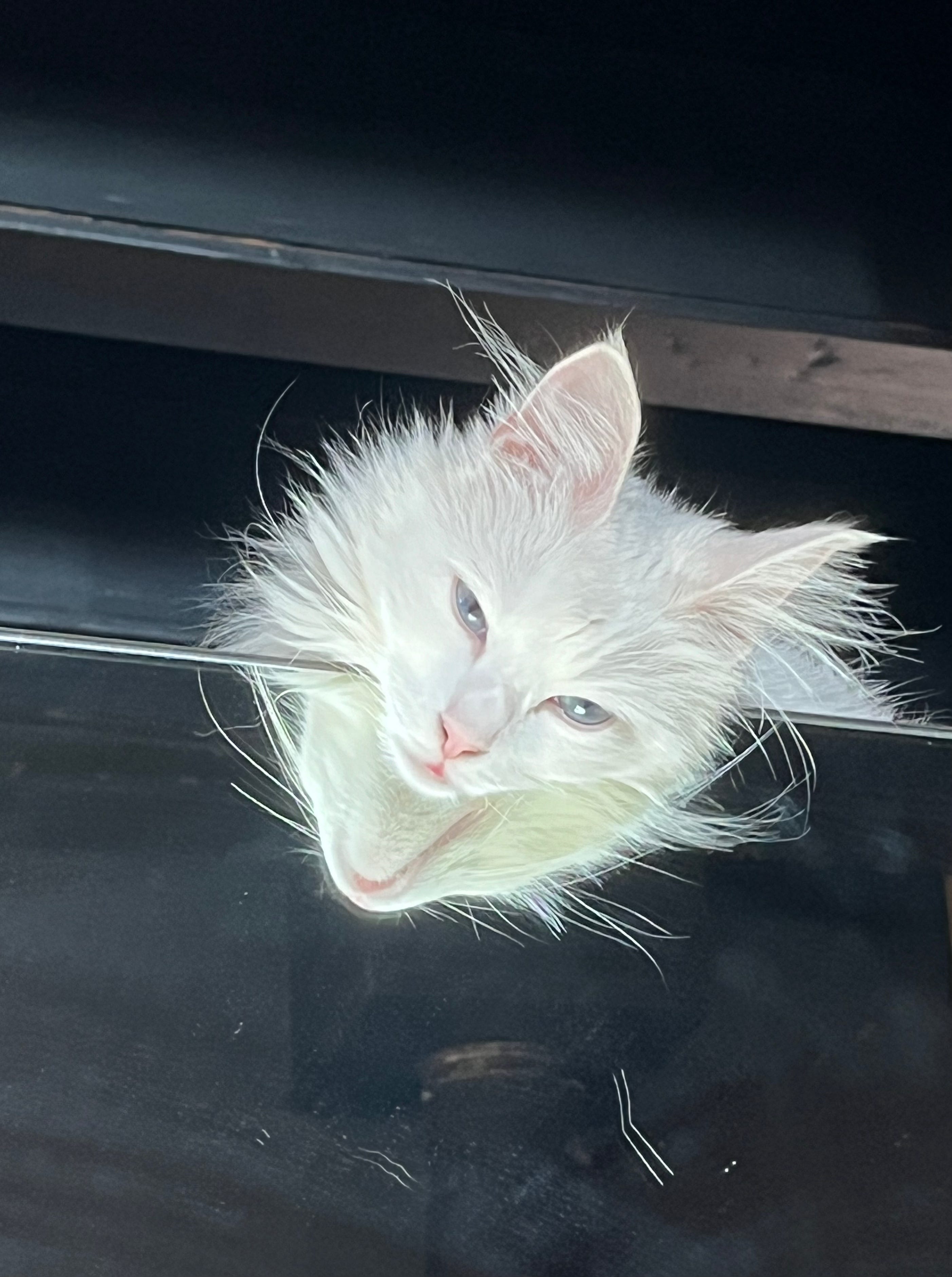
My cat died the other day. A delivery person left our doors wide open when he left, and the cat, thrilled by the prospect of a forbidden foray into the city, rushed out into the street and under the wheels of the car of one of the drivers honking impatiently at the delivery vehicle blocking the road. The death of a household fellow creature is a common experience. It’s one I’ve had many times in my much-longer-than-feline lifespan. But this time it was different. Perhaps I was primed for a profounder sadness by the sudden loss of a close human friend just a month before. But this interspecies multiplier effect, while unquestionably pertinent, is not enough to fully explain the depth of my sadness. This particular cat was an extension of my body and my being, more a daemon from Philip Pullman’s His Dark Materials than a pet. The severing of the connection drew to the surface feelings of a more sweeping scope that had been brewing in my viscera, specific neither to cat friend nor human friend, encompassing both. I gathered the animal’s body from under the parked car it slipped beneath, and as I wrapped it in a remainder of silk fabric for burial, a quick succession of images invaded my brain. They flashed before my eyes like a news roll. People stooping and retrieving, as I had done by the parked car, but on piles of the rubble of what used to be their home. Grieving adults carrying small shrouded bodies through rubble-strewn streets quickly followed. As the images rolled, I heard these words, in a voice-over: if it hurts this much to lose a cat, what must they be going through with the loss of their children? The multiplication of sadness multiplied again, exponentially, outpacing even the mounting body count in Gaza. Beyond measure. I was inconsolable, and have remained so since. How can the sadness of this world be borne? How will it ever break?
Cruelty. There is the cruelty of a fortuitous event occurring at an unfortunate confluence of movements, such as a cat’s irrepressible enthusiasm for exploration colliding with the lumbering advance of one of the metallic hulks strangling our city streets. A strike of fate. But then there is organized cruelty. Cruelty that is nurtured and tended, regularized and systematized, positively reveled in. The march of hate. Is it not enough that we will inevitably encounter the first kind? Must we add to that the second? The sadness produced by the march of hate on top of the sadness that hits with the strike of fate. Too much, all around. The too-much of it was what surfaced in me.
I think I know the reason my connection to my cat was so deeply daemonic. It’s a commonplace to say that when we form an emotional bond with our companion animals it’s because we’re anthropomorphizing them. We’re misrecognizing ourselves in them, and only loving the way they mirror us. Species-specific narcissism. It is true that this is often the case. It is equally true that it need not be the case. In this case, it wasn’t. What connected me to my cat was the opposite: the feeling of unfathomable alienness in her. I would often sit and watch her watch out the glass doors of the terrace into the wildness surrounding our house in the forest that was her second home. She would stare, rapt, for most of every night, for hours on end, into what for me was featureless darkness. Would that I coud see through her eyes! What hold does that darkness have on the mind of a cat? What would it be like to see as she sees, to hold to the darkness as she does? To feel the feline lure of the night? The quirky interests and obsessions she pursued throughout the day were just as incomprehensible. I have my interests and obsessions, but being ever vigilant for the opportunity to push a glass off a counter and cackle in delight at the crash is not among them. Aesthetics is important to me, but I don’t take it as far as she did. Every angle from every elevation, crook, and cranny offered a unique perspective that had to be experienced and relished. Every change in the house, every new object or arrangement introduced, had to be thoroughly investigated and, in the end, slept on to put a seal on its addition to the changing experiential matrix. She went from aesthetic adventure to aesthetic adventure. I did not relate to her through what we had in common, but through what in her aesthetic existence was most singular, thus most incommunicable: most alien. Our lives were not similar. They intersected, across their mutual alienness, in cross-lines of play and affection, and mutual study and observation. We did not live in the same world. Our lives were not like two contents in the same spatial container of a common world. We intersected at certain dynamic coordinates in each of our lives, on certain levels where our life-line could effectively cross. The togetherness of our life together was like a complex diagram of intersecting vectors and planes composing its own, ungeneralizable space. Cats differ from dogs in that they retain an unexpungeable residue of undomestication. There is a remainder in them of irremediable catness that can make no human sense. I think that is why some people hate cats: they’re irrepressibly themselves. They never give themselves wholesale over to you. You cannot own or dominate them. You have to find the angles where your life can affectively, aesthetically intersect with theirs, and gently invite them to share in the encounter. I have lived with many cats. In fact, at no time in my life have I lived without a cat. But this cat was the most cat. She was wild at heart, as nearly all residue of undomestication as a domestic cat can be. I loved her for that alienness, and the surprising way that it did not exclude a radical openness to human encounter. It gave me a sense that there is more world to the world, or other worlds imbricated with mine. Not so much communicating their natures or even contents to each other, as offering extensions of each other’s lines of exploration. My feline daemon gifted me a sense of existential expanse extending, beyond my self-centered preoccupations, into wondrous worlds I would never enter. But with which I could nevertheless effectively, affectively intersect on an everyday basis, to (I hope) mutual experiential enrichment.
When you think about it, the situation is not so different human-to-human. We can never feel what another feels. There is a irremediable, incommunicable, inimitable remainder of otherness at the heart of every human. The affective life that defines us is, at bottom, as unshareable as our birth and death.Try as we might to domesticate ourselves – and each other – we are all aliens on this earth. We stare together, apart, into the night. There is no common world. And it is because of that, not in spite of it, that we can bring each other mutual experiential enrichment of the intensest kind. It is only on that condition that we can extend our lives together, with wonder, into worlds beyond our self-centering, and beyond our common ken. It is because of this that we can travel into the more-than of the world, as we commonly claim to know it already.
Why can we not love the alienness in the other? Why can we not cherish the foreignness at the bottom of every heart? Why can we not be daemons to each other?
We can, at some cross-lines and on certain levels. But we are trained to turn away from them – in the name of humanity. My friend who recently died is an example. The village saw him for his humanity, and judged accordingly. By that standard, he was lacking. His lifelong nickname in the village was “Minus.” If he had grown up in our pathologizing times, he would undoubtedly have been judged autistic, with a learning disability and ADHD. He struggled with the conventions of sociality, experiencing their superficiality and insincerities with unspeakable disappointment and deep emotional suffering. He was a creature of the forest. A wild one. In the forest, and with friends who connected to his undomestication, he glowed. His acute intelligence and relational sensitivity sparkled. I did not judge him as many of the villagers did. I appreciated his wildness and what it carried – but oddly (this is hard to admit), not as intensely as I did the cat’s. The intensity was dampened somewhat by the mediating frame of our common humanity, which interposes between us conventions of boundedness and guardedness, in particular between men. By contrast, I could connect directly, and without reserve, to my cat’s unhumanness. Since I was a small child, I have always felt a more direct comaraderie with animals. With my own human kind, especially the adult male kind of my kind, I felt a reticence. To this day, I experience a diffidence in the human-to-human that it takes time and effort to overcome. Humans’ humanity disconnects us from the more-than-human in us, through which our lives intersect with other worlds, to the aesthetic enrichment and existential intensification that I, like my cat, crave, and that give me a sense of thriving, more so than any human comfort or accomplishment. I am fortunate to have the example of my life partner, whose own neurodiversity affords her no such tentativeness. She can see-feel straight through to the undomestication remaindered by humanity, and connect directly to that. Her way with our friend, and the deep, uncommon friendship she forged with him, was a living example to me to better learn to curb my human mediation.
We are so schooled in the rhetoric and sentiments of humanity that these comments might strike some as irresponsible, even egregious. But consider: our ideas of humanity are based on an assertion of commonality. The affirmation of commonality is meant as an inclusive gesture. But the inclusion is in fact the setting in place of the conditions for hatred.
US Vice President Vance has made this abundantly clear. He embraces a theory of commonality extending outward in concentric circles from the core: the breeding, heterosexual family unit. That is already a mighty exclusion of human diversity. Our love and support for each other, he says, must be anchored to that core. It can then extend, with less intensity, to then next circle: our neighbors, defined as those with whom we feel a common bond of extrafamilial community. There is an exclusion from this circle as well, since we do not in everyday point of fact feel a bond with those among our neighbors we judge not enough like us, on racial, ethnic, political, religious, or gender-difference grounds. Those whose humanity is foreign to us fall outside the circle, appearing as interlopers horning in on a level of proximity and intimateness to which they are not entitled. After this local circle comes the national level, where we are exhorted to feel the common bond of patriotism, the most abstract of common bonds but arguably the most pernicious. At this level, all the exclusions of the previous two levels are raised to a higher power, and hardened. The degree of hardening is measured by the harshness of immigration policy, outer border guard of the concentric circles of the common. The hardest of the hardening occurs when the commonality of the protected patriots inside the magic circle of the state is defined in religious and/or racial and ethnic terms.
This is the case with Vance and his common fellows in MAGA world. The entire structure of commonality for them rests on white, Christian nationalism. The recent memorial rally canonizing Charlie Kirk after his assassination left no room for mistake on this. Kirk, a small man with large hatreds, became the patron saint of an energized movement wielding a bellicose rhetoric just a step away from a call for civil war. War: the natural expression our common humanity. What march to war has not drawn a rigid line of exclusion between them from us, exalting the exemplary humanity of the us while dehumanizing the them as no better than animals (and not in the good way: as the other of human, simply the negative of its common likeness, rather than a portal to the worlds of difference of more-than-human)?
At this point, civil exclusion turns barbarous. This is the turning point where the excluded become the killable. The point where a genocide of Palestinians can be smoothly denied or simply overlooked, because their humanity has long since been them-ed to abjection, as the abhorred other to the us. The point where the Brown or Muslim immigrant next door is deemed an existential enemy and blithely disappeared into the concentration camps of a rapidly growing gulag, to be extradited to a country, sometimes one they have never been to, in which their life is in danger (if they’re lucky, and don’t disappear indefinitely into detainment). Where our transgender neighbors are deemed unworthy of life-saving medical and social support and are deprecated in language that puts a target on their backs for violence. Where populations beyond the national borders are nonchalantly condemned to death in the millions by disease and hunger following from the brutal withdrawal of aid.[i] Where an unseemly glee for dismantling climate and environmental measures will condemn countless more to similar deaths. Across the turning point, a vast machinery of repression can already be seen on the horizon, stretching forward from foundations firmly planted in the present in the form of rapidly expanding militarization of government functions, fed by a fury to paint the political opponent as the enemy.
At the Charlie Kirk canonization, President Trump, in his usual unthinking manner, blurted out what most speakers at the same forum conveyed only in the way they carefully tiptoed around it. “I hate my opponents, and I do not wish them well.” Fine Christian-nationalist sentiment. Note that he is talking about the 60% of the American population who oppose him, but whom he was theoretically elected to represent. The fact that these most un-Christlike words were proudly spoken – and heartily approved of – at an event organized on the model of a Christian religious revival meeting indicates that the growing machinery of repression is fueled by an affective tonus that is stronger than doctrine. There is an affective regime governing the transition to the turning point and its fascist beyond. It is made of the fear and hatred that is both the pretext for and the result of the machinery of exclusion and the rendering killable. The fear and hatred are vectors of reaction: the reflex irruption of the affective tonus in an act of push-back and attack. Ressentiment: the consolidation of fear and hatred into a mode and motor of life.
In the life of ressentiment, cruelty is normalized. Every day’s news is filled with new examples of this. When fear and hatred are as yet unconsolidated into an integral mode of life motoring on with machinic implacability, cruelty irrupts punctually, as a side-effect, in flashes of reaction. As Henry Giroux has recently written, under present conditions,cruelty is not like this. It is not a side-effect. Cruelty is the point.[ii] It is reveled in. Trump as president, this second time around, is the glorified personification of cruelty. His followers are the little hands of cruelty extending its reach throughout the social fabric.
Reaction circles back on itself, in self-intensifying spasms of crueltly. The Jewish people were excluded and declared killable by the Nazi regime, resulting in the Holocaust. A certain segment of the Jewish population steeled themselves against the possibility of the Holocaust recurring by identifying their fate with the bulwark of the state of Israel and its militarization, built on a self-defensive sense of Jewish commonality. This project was predicated on the exclusion of the Palestinian, starting with the Nakba. The process continued through a long series of wars and colonial oppressions, reaching its apogee in the reactive response triggered by the October 7 attacks that rendered the Palestinian eminently killable. The October 7 massacre of Israeli civilians was itself bound up with a reactive response, with its own long history, throwing back upon the Israeli oppressor the status of the killable. Round and round it goes, making a tautology of cruelty. Even good intentions get twisted in the churn. Charlie Kirk’s killer is a case in point. Why did Tyler Robinson kill Kirk? He said it was because he could no longer countenance Kirk’s hatred. Not countenancing hatred is not a bad goal. Robinson killed Kirk because he hated his hatred. There’s the irony. He delivered him to cruelty because he was cruel. The reactive fallacy is too obvious to comment upon. Where does any of this get us? Only back to where we started. A tautology never concludes. It just reproduces its own premise. How can that vicious cycle be broken?
Circling back: how can the sadness of this world be borne? Of this world of ressentiment that makes it so that if we are not inconsolable, it can only be a sign that we are not awake.
The liberal order ushered in by the Enlightenment and the noton of universal (in practice, exclusionary) humanity that codified it are on their last legs, like somnabulists teetering into the twilight of the humanist idols. In spite of it all, it shuffles on, in many domains and on many levels. When was the last time you read a literary book review in the press or listened to a literary award competition where you did not hear the words, repeated ad nauseam: it transcends its particular context to bring out our common humanity. It’s a universal story. It makes us understand each other, in all transparency, no remainder. It enables the reader to empathize with the other. Never mind that the other at that point is no longer other, but a mere reflection of us, its defining difference crushed by the imputation of human commonality. This – not affirming the glimpse of the more-than-human seen in a cat’s eyes or the sparkle of a human Minus – is what is truly egregious: erasing the singularity of culture, the divergencies of experience, the uniquenesses of language and history, all with the brush of the supposedly universal. Distilling out the alienness like a contaminant to be flushed away. Devaluing foreignness like some kind of adulteration. The notion that what confers value is commonality and universality is the signature cruelty of liberal tolerance, battering difference under the hammer weight of all-too-human empathy. Although infinitely preferable to its fascist counter-tendency, it is probably not a bad thing that its order is dying.
Circling again: why can we not love the alienness in the other? Why can we not cherish the foreignness at the bottom of every heart? Why can we not be daemons to each other?
When can we stop anthropomorphizing each other?
I concluded my last Substack post on the “Man-Standard” and speciation by saying I would give an example of more-than-human speciation in a human multiplicity. The idea was an attempt to exemplify the kinds of becomings that render us, if not unsad, if not consolable – there will always in any case be that first kind of cruelty – yet still intensely alive to the world(s). That provide, perhaps, tentatively, and speculatively, a vision of a path over the turning point with a different affective tonus, one that does not circle back tautologically. A forking path from the trajectory we are on. My overtaking by sadness preempted that intention. I will try to move forward to it in my next next post.
There is urgency. We have traveled much farther down the path to fascism far faster in the last eight months than anyone, even the most pessimistic, would have predicted. We don’t have much time left before the march becomes irreversible, at least on the time scale of generations. It is not a question of finding optimism – a human self-conceit with no parallel in nature. It might well, however, involve refinding wonder, a more-than-human wonder, perhaps not unrelated to what Philip Pullman, in an early, long forgotten work, called the “amorous inclinations of matter.”[iii]
[i] Jonathan Lambert, “Study: 14 Million Lives Could Be Lost Due to Trump Aid Cuts,” Npr.org, July 1, 2025, https://www.npr.org/sections/goats-and-soda/2025/07/01/nx-s1-5452513/trump-usaid-foreign-aid-deaths.
[ii] Henry Giroux, “Trump’s Theater of Cruelty,” Counterpunch, September 15, 2025, https://www.counterpunch.org/2025/09/12/trumps-theater-of-cruelty-2/.
[iii] Philip Pullman, Galatea (New York: Dutton, 1979).
Beautiful post… I love the intimacy of grief connecting through to a broader critical engagement with monstrous affect.
This touched me to my core